Expertise
Our expertise: safe, to standard, responsible
This page is not about how to book us — it is about how we work: licensed, with documented procedures and a clear position on conservation and safety.
Certified & insured
Why you can trust us
When someone climbs onto your roof or opens your roller shutter box, you need to be able to trust them. That is why we work with proof of qualification only:
VFB-S licence
Federally certified pest controllers (Fachbewilligung VFB-S) — not hobby nest removers.
Reports to SN EN 16636
Every job documented — you know exactly what was done.
SUVA-compliant
Secured work on roofs and ladders — even for nests that are hard to reach.
Fully insured
Public liability insurance covers every job — your home is protected.
Licensing & the legal framework
Pest control on wasp and hornet nests is not an unregulated activity in Switzerland. We work within the framework the law sets out — and we are happy to be judged by it.
Our work is based on the Fachbewilligung VFB-S, the federal licence for handling biocides in pest control. Every job is documented to SN EN 16636, the European standard for professional pest management services — recording the findings, the method chosen and the outcome. That keeps every callout traceable after the fact, including for insurers or property managers.
Our working practices are also SUVA-compliant (the Swiss accident insurance fund's safety rules), and every job is fully insured — for our safety as much as for yours.
At a glance
- Licence
- VFB-S
- Job standard
- SN EN 16636
- Occupational safety
- SUVA-compliant
- Biocide law
- ChemRRV
- Insurance
- Fully covered
Our licence, in the original
No claim without proof: the federal Fachbewilligung VFB-S for the use of biocidal products in general pest control — issued to our technical manager and confirmed by the FSD-VSS examination board.
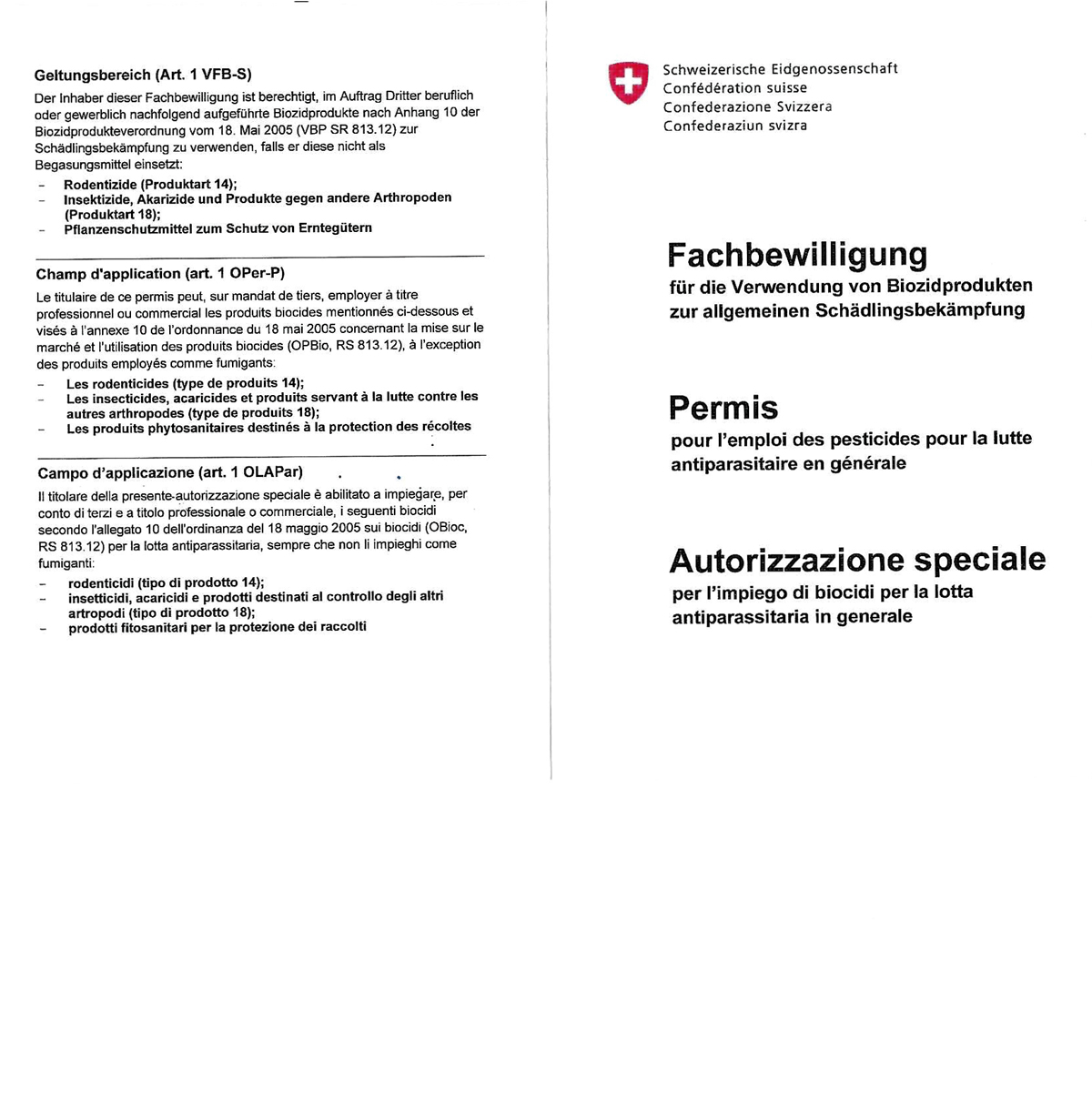
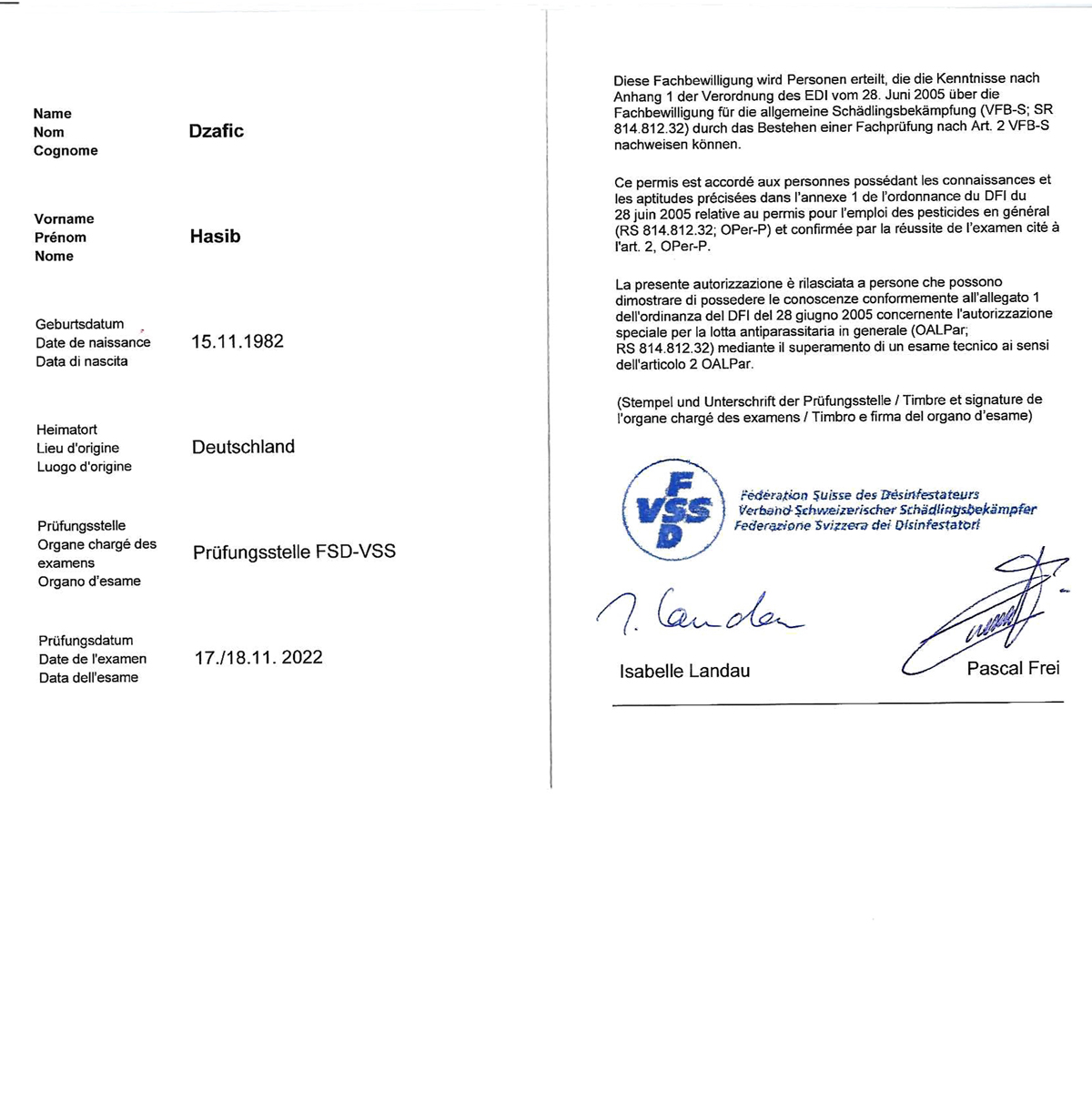
- Holder
- Hasib Dzafic
- Licence
- VFB-S · SR 814.812.32
- Examination board
- FSD-VSS
- Examined
- 17/18 Nov 2022
Our four methods — and when we use them
Not every nest calls for the same treatment. We work consistently from the gentlest method to the most invasive.
Cold treatment
A specialist freezing agent shock-freezes the nest within seconds. The insects become inactive without any chemicals — our preferred method whenever the nest is accessible enough.
Mechanical removal
The entire nest is taken down in full protective gear and disposed of in a sealable container. Clean, no residue, no biocides.
Relocation
For beneficial or protected species such as the European hornet, paper wasps or bumblebees, we always check first whether the colony can be relocated alive to a harmless spot before considering anything else.
Biocides
Only where the location, size or an acute risk rules out a gentler method do we apply an approved biocide — precisely targeted, carefully dosed and never as a default solution.
Handling biocides properly
Where a biocide is genuinely needed, we use it in a controlled way and within the law — not as a convenient default.
- Used only where professionally necessary — never routinely or as a precaution.
- Applied precisely at the nest itself rather than sprayed over a wide area.
- Only approved products under the Swiss Chemical Risk Reduction Ordinance (ChemRRV).
- Product, quantity and application point recorded in the job report.
- Customers are told about waiting times and how to behave after treatment.
Protective equipment & personal safety
Safety starts with the equipment — for our technicians just as much as for anyone nearby while we work.
- Certified full protective suits, gloves and face protection to SUVA (Swiss accident insurance) standards
- Specialist vacuum units for gentle, biocide-free removal of entire nests
- Lifting platform and climbing equipment for nests in hard-to-reach places
- Cold-treatment equipment for a chemical-free first approach
- Personal first-aid kit carried on every job in case of emergency
Honest advice & conservation
For us, expertise shows not only in how a job is carried out, but in what we recommend in the first place.
Assess first, act second
We only ever recommend what is professionally necessary — even if that means advising against removal and suggesting you leave the nest alone or have it relocated instead.
Protected species are spared
Wild bees, bumblebees and other strictly protected species may not be destroyed under Swiss law. We identify the species reliably and act accordingly — see our species guide for more.
Relocation before destruction
With beneficial, low-aggression species, destruction is our last option rather than our first. Wherever relocation is professionally justifiable, that is what we do.
Find out more about us
These principles apply to every job — whether at your home or under a framework agreement for property managers and businesses.
Found a nest? Give us a call.
A no-obligation assessment by phone — usually on site the same day.